Tiny Ride
- 3.4
- Rating
- 10.00K
- Installs
- Free
- Price

 Analysis by App-foxy
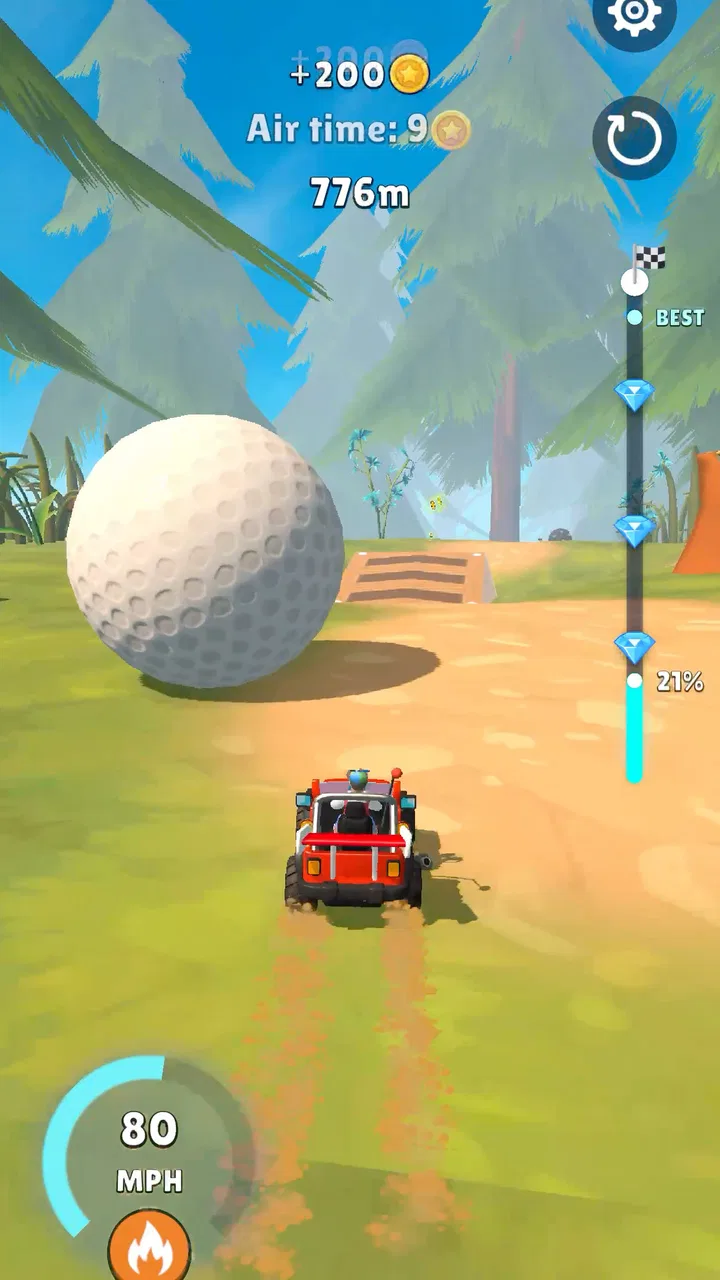
I went into Tiny Ride expecting a quick racing game, and that is exactly the kind of experience it presents: a small-scale car adventure designed around immediate movement rather than a long introduction. The first useful thing to know is that this is a game from Playfo, listed in the Racing category and offered free of charge. Its compact identity is clear from the moment you begin: you are not preparing for a serious driving simulation, but looking for a light session where a tiny vehicle, a short burst of attention, and the next attempt are the main ingredients.
That simplicity is both its appeal and its main limitation. I can imagine opening it while waiting for a bus, taking a short break, or wanting something less demanding than a full racing game. At the same time, players who expect deep vehicle tuning, a large competitive structure, or the technical precision of a simulation should adjust their expectations. The experience works best when treated as a focused miniature ride rather than a replacement for a larger racing title.
How the tiny-car loop feels in practice
I find the tiny-car loop easiest to judge when I treat each run as a small test rather than a race I need to finish at all costs. That mindset helps me notice whether a restart is teaching me something or merely repeating the same frustration. From there, the practical question is what to check before blaming the game when a session feels rough.
You May Also Like

 AccuWeather: Weather Radar
AccuWeather Review: A Quick, Clear Forecast for Everyday Decisions
For everyday plans, the best forecast is the one you can understand quickly. AccuWeather makes rain timing, radar, and local conditions easy to act on, with a few trade-offs.

 Hill Climb Racing
Why Hill Climb Racing Still Turns Crashes Into One More Run
A tiny car, a bumpy hill and one more upgrade: Hill Climb Racing keeps resurfacing because its simple chaos makes every near-miss feel personal.

 AliExpress - Shopping App
AliExpress Makes Global Shopping Feel Personal, but Shoppers Bear the Risk
AliExpress turns a global marketplace into a pocket-sized discovery engine. Its reach is useful, its shopping loop compelling, and its trade-offs easy to miss.

 Lords Mobile: Kingdom Wars
Lords Mobile Is a Kingdom-Building Routine, Not a Quick Match
A case-by-case verdict on the building, battles, device demands, and social commitments that make Lords Mobile rewarding for some players and exhausting for others.

 PDF Scanner app - TapScanner
TapScanner Makes Paperwork Easier to Capture, Check, and Share
TapScanner makes scanning with a phone feel less like a rescue operation and more like a dependable step in getting work done. Its capture tools are useful, though not flawless.

 Block Blast!
 Shows How Much a Puzzle Game Can Leave Out
A quiet grid game shows why puzzle players increasingly value instant clarity, repeatable skill and low-pressure play—and where the genre still needs to catch up.
More From Our News Desk
View All News


The first action is deliberately easy to understand
The strongest part of the opening is how little mental preparation it seems to require. A game built around a tiny car benefits from getting the player into motion quickly, and Tiny Ride’s concept naturally supports that. I do not approach it as a game that needs a long planning phase. I approach it with one simple question: can I keep the car moving cleanly through the immediate challenge?
That first action matters because it establishes the entire relationship between the player and the game. Instead of studying a dense menu or learning a complicated driving model, I am watching the road, reacting to what appears, and trying to make a better decision than I made a moment earlier. For casual players, this low entry barrier is valuable. Someone who rarely plays racing games can understand the purpose without needing a tutorial-heavy explanation.
The tiny scale also changes how I read the screen. A miniature vehicle makes every movement feel more exposed. Small corrections become important, and a mistake can feel more noticeable because the car occupies such a limited visual space. That gives the game a playful character, but it also means I would not recommend playing carelessly and expecting the game to carry the whole experience for me. The fun comes from paying attention to the car’s position and responding before a harmless-looking situation becomes a failed run.
One practical tip is to begin with controlled movements instead of immediately chasing speed. In a short racing session, players often react too early because they are focused on the next obstacle or turn. I found it more useful to watch the car’s current line first, then make the smallest correction that keeps the run stable. That habit is especially helpful for anyone coming from arcade racers where exaggerated steering can sometimes be recovered easily.
Feedback gives each attempt its shape
The central rhythm is built from action and response. I do something with the car, the game shows me whether that decision worked, and I use the result to change the next input. This feedback rhythm is more important here than any individual moment of speed. A successful movement gives me a reason to continue, while a poor one tells me exactly where my attention slipped.
That makes Tiny Ride feel more immediate than a conventional race that depends mainly on finishing position. The satisfaction is not only in reaching the end of a course. It is in keeping a fragile-looking run alive for another moment, then another. When the car responds well to a correction, the reward is personal: I know the improvement came from better timing rather than from simply waiting for an upgrade or relying on a stronger vehicle.
The trade-off is that this kind of loop can become repetitive if the available action does not keep feeling fresh. Players who need a broad selection of cars, extensive tracks, or a strong sense of long-term progression may find the small-scale design too narrow. I would judge the game by the quality of its short interactions, not by the standards of a full racing package.
For everyday use, that distinction is important. If I have only a few minutes, I want feedback that arrives quickly. A run can be satisfying even when it ends soon because I immediately understand what went wrong. If I am sitting down for a long evening, however, I would probably choose a more expansive racing game with greater variety. Tiny Ride is better at creating a compact challenge than at promising an all-night driving session.
What counts as a reward
The reward structure is best understood through the feeling of maintaining progress. In a small racing game, a clean section of driving becomes its own achievement. I get a sense of success from avoiding a mistake, holding a good line, or reaching a point that previously stopped me. That kind of reward is modest, but it is also immediate and easy to understand.
I like this approach because it does not require me to treat every session as a major commitment. I can play for a short while, make one useful improvement, and leave with the feeling that the attempt was worthwhile. The game’s free price also lowers the barrier for trying it, especially for players who want a casual racing experience before deciding whether they enjoy its style.
Still, free access does not automatically make every player a good match. If your idea of reward is collecting a large garage, unlocking elaborate customization, or competing through a deep ranking system, this may not provide enough motivation. I would choose it for the pleasure of the drive and the quick return to action, not for a long list of ownership goals.
A useful way to play is to set a personal target before starting. Instead of asking only whether I completed a run, I might focus on making fewer rushed corrections, staying calm through a difficult section, or beating my own previous result. This turns a simple attempt into a small practice session. It also prevents the common problem of repeating the same mistake without learning from it.
The reset is part of the appeal
The reset after a failed attempt is not merely a punishment. It is what keeps the game’s loop moving. Once a run ends, I already know what I want to change: react later, position the car more carefully, or avoid repeating the input that caused trouble. Because the experience is built around short actions, restarting does not feel like abandoning a large investment of time.
This is where Tiny Ride can fit neatly into a busy day. A failed run does not need to ruin the session. I can treat it as information, begin again, and test one adjustment immediately. That action, feedback, reward, and reset cycle gives the game its strongest reason to ask for another attempt. The next session begins because the previous one revealed a specific mistake I believe I can correct.
There is a downside for players who dislike repetition. If a reset sends you back through the same type of challenge without enough variation, the loop may feel less motivating after several attempts. I would skip this game if I know I become frustrated by restarting small sections or if I need constant novelty to stay engaged. A more content-heavy racer would be a better choice in that situation.
My advice is to stop after a few unproductive attempts rather than forcing the issue. Tiny Ride is more enjoyable when I return with a clear adjustment in mind. Playing while irritated makes the controls feel worse and turns a potentially useful reset into a cycle of hurried mistakes. A short break can make the next run feel like a genuine test instead of another automatic restart.
Who will enjoy this racing style?
I see the best audience as people who want an approachable arcade-style challenge with a compact identity. It suits a player who enjoys testing reactions, prefers short sessions, and likes the satisfaction of improving through repetition. It can also work as an introduction for someone who finds larger racing games intimidating, because the idea of guiding a tiny car is easier to grasp than managing a detailed simulation.
It is less suitable for someone searching for realistic handling, a broad career mode, or a substantial multiplayer-focused experience. I would also be cautious about recommending it to players who measure value mainly by the amount of content available over many hours. The game’s charm comes from concentration and immediacy, so its appeal depends heavily on whether that narrow focus feels satisfying to you.
The age classification is Teen, which is worth keeping in mind for families choosing games. I would still make the decision based on the individual player’s comfort with racing pressure and repeated failure rather than assuming that every casual car game feels identical. The rating gives useful context, but personal preference matters more here because the main challenge is the repeated attempt to improve.
Device expectations and the current release
Tiny Ride is available for devices running Android seven or later, so it is positioned for a fairly broad range of Android users. That makes it easier to consider on an older compatible phone instead of assuming that a recent flagship is necessary. Even so, I would keep the usual practical habits in mind: close demanding apps if the phone is already struggling, and avoid judging a short racing game while the device is affected by unrelated performance problems.
The current version is 1.0.3. I mention that because the game is still early in its release life, and early versions can feel more like a starting point than a finished destination for players who expect years of accumulated content. The developer is Playfo, and the game has reached over ten thousand installs, giving it a modest but real audience rather than making it an entirely unknown experiment.
Its average rating is 3.4 from eighteen ratings, with eleven written reviews. I read that as a reason to approach it with balanced expectations. There is enough interest for people to try it, but the score does not suggest that it will satisfy everyone. For me, that fits the design: the focused loop can be appealing when it matches my mood, yet the same simplicity may leave another player wanting more variety.
How it compares with familiar racing alternatives
Compared with a simulation racer, Tiny Ride is much easier to pick up. I am not choosing it for realistic vehicle behavior or a detailed recreation of motorsport. A simulation is the better option when I want careful braking, tuning, authentic tracks, and a sense that every mechanical adjustment matters.
Compared with a large arcade racer, Tiny Ride appears more concentrated. Big arcade games usually offer a stronger feeling of spectacle, a wider selection of vehicles, and more reasons to keep progressing. I would choose one of those when I want a longer session or a stronger collection system. Tiny Ride makes more sense when I want the driving challenge itself to arrive without a large amount of surrounding structure.
It also differs from endless runners that happen to include vehicles. In an endless runner, the pressure often comes from surviving an uninterrupted stream of hazards. Here, the miniature-car idea gives the experience a more deliberate racing identity. That distinction may appeal to players who want a car-focused challenge but do not want the scale or commitment of a full racing campaign.
The important trade-off is depth versus accessibility. Tiny Ride’s approachable format may help it become a quick daily diversion, while a more ambitious alternative may reward a longer-term player with richer systems. Neither approach is automatically better. I would install this one when I value a fast start and a clear retry loop; I would choose another game when I want a garage to manage, a championship to complete, or a more demanding driving model.
Small habits that make each run more useful
The first habit I recommend is separating observation from reaction. I try not to move the car simply because something appears on screen. I first identify where the car is, then decide whether a correction is actually needed. This reduces oversteering and makes the feedback easier to interpret after the run.
The second is to change only one behavior after a failure. If I alter timing, direction, and speed all at once, I cannot tell which change helped. A more useful workflow is to remember the point where the run broke, choose one adjustment, and test it on the next attempt. That turns repetition into practice instead of guesswork.
The third is to use short sessions intentionally. Rather than playing until every attempt feels identical, I prefer to stop while I still understand what I am learning. Returning later can make the reset loop feel fresh again. This is a particularly good fit for Tiny Ride because its value is concentrated in the clarity of each attempt, not in forcing a long continuous play period.
Finally, I would avoid comparing every run with a perfect result. The game is more rewarding when I notice smaller improvements: a cleaner opening, a calmer response, or a better recovery after a mistake. Those details are easy to miss if I focus only on whether the entire attempt succeeded.
My verdict on the action-feedback-reset cycle
Tiny Ride works when I accept its scale. The first action is accessible, the feedback arrives through the car’s immediate response, the reward comes from keeping a run alive and improving my decisions, and the reset gives me a clear reason to try again. That loop is simple, but it is not empty. It can make a short break feel active without demanding the commitment of a larger racing game.
My recommendation is therefore specific: try it if you want a free, compact racing experience built around repeated attempts and personal improvement. I would not make it my first choice for simulation fans, collection-focused players, or anyone expecting extensive long-term content. For the right mood, though, its tiny-car premise has a practical strength: I can start quickly, understand a mistake, and return to the road before the moment has passed.
After spending time with it, I see the next session as the game’s real reward. Not because every attempt promises a dramatic unlock, but because each reset leaves me with one clear question: can I handle that moment better now? If that question is enough to keep you engaged, Tiny Ride is a worthwhile little racing diversion. If you need a broader world around the driving, look toward a fuller alternative instead.
FAQs for Tiny Ride
01What is Tiny Ride, and how does the game work?
Tiny Ride is a casual driving game focused on short, entertaining rides rather than realistic simulation. After installing it, players can usually guide a small vehicle through compact tracks, avoid obstacles, collect items, and try to complete each challenge successfully. Its simple controls make it easy to start playing, while progressively harder courses provide enough variety for short gaming sessions.
02Is Tiny Ride suitable for children and beginners?
Tiny Ride is generally approachable for beginners because its gameplay is easy to understand and does not require advanced driving skills. Younger players may also enjoy the colorful presentation and straightforward challenges. However, parents should still check the current store rating, advertising policy, and any in-app purchase information before allowing children to play, since these details can vary between versions and devices.
03Does Tiny Ride require an internet connection to play?
The basic driving experience in Tiny Ride may be available without a constant internet connection, which makes it convenient for quick sessions while traveling or when mobile data is unavailable. Nevertheless, some features—such as advertisements, online services, updates, leaderboards, or purchases—can require connectivity. It is best to launch the game once online after installation and review which functions remain accessible offline.
04Are there advertisements or in-app purchases in Tiny Ride?
Tiny Ride may include advertising or optional in-app purchases, as is common with free mobile games. Advertisements can appear between levels or after completing an attempt, while purchases may offer cosmetic items, bonuses, or ways to remove ads, depending on the version. Before downloading, users should read the Google Play or App Store listing carefully and protect purchases with device authentication.
05What devices are compatible with Tiny Ride, and is it free to download?
Tiny Ride is distributed for mobile devices through an official app store, but compatibility depends on the operating system version, available storage, and the developer’s current requirements. The game may be free to download while offering optional paid content. Check the official listing for the latest Android or iOS requirements, file size, supported devices, and regional availability before installing it.
Pros
- Simple controls make it easy for new players to start riding.
- Short sessions are convenient for quick breaks or commutes.
- Bright visuals give the game a cheerful
- accessible style.
- Unlockable content adds a reason to keep playing.
- The lightweight design should run well on many mobile devices.
Cons
- Gameplay may feel repetitive after extended play sessions.
- Progress can become difficult without careful timing and practice.
- Small screens may make some obstacles harder to judge.
- Ads or in-app purchases may interrupt the overall experience.
- The game may offer limited depth for players seeking long-term variety.

Tiny Ride
Gallery